NEO was commissioned by the Traffic Safety Data Taskforce to map all zebra crossings in the Netherlands using Geo AI. With this information, road authorities and policymakers can make better decisions to make traffic in the Netherlands a little safer again.
To increase road safety in the Netherlands, the Road Safety Data Taskforce wants to make data accessible for risk-based road safety policy. Research by SWOV shows that a substantial proportion of pedestrian fatalities occur on pedestrian crossings. According to SWOV is to improve pedestrian safety with a pedestrian crossing by applying measures such as signs and speed bumps. One of the conditions for taking this up is a registration of the locations of pedestrian crossings, also known as zebra crossings. There was no registration of pedestrian crossings in the Netherlands until now.
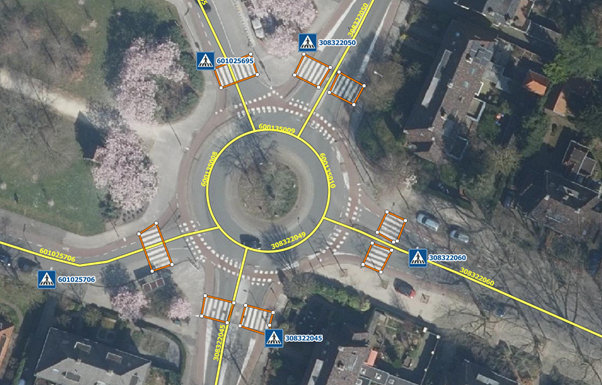
This has now changed now that NEO has mapped pedestrian crossings nationwide based on aerial photographs. Road authorities now know where all pedestrian crossings are and can use this data to further enhance road safety and reduce road casualties, one of the objectives of NDW's work for the Road Safety Data Taskforce: https://www.ndw.nu/onderwerpen/verkeersveiligheid.
NEO has deployed artificial intelligence (Geo AI) to use Imagery's open data to automatically recognise zebra crossings and capture them as objects. In this way, more than 50,000 zebra crossings were captured. A cross-check was also performed on the traffic sign file and it was determined for each zebra crossing whether a traffic sign was present or not. The data was delivered in the format of the road sign database and can be downloaded from the National Roads Database (NWB) download site: https://downloads.rijkswaterstaatdata.nl/wkd/voetgangersoversteekplaatsen
The data can also be updated in the future with new aerial photos and satellite images: NEO specialises in keeping registration of our living environment continuously updated by always automatically processing the most recent images.
According to Steven Braakman of NEO, monitoring assets and infrastructure is one of NEO's specialities. As part of environmental information for road safety, NEO also works on other datasets, such as obstacles along roads and cycle paths.